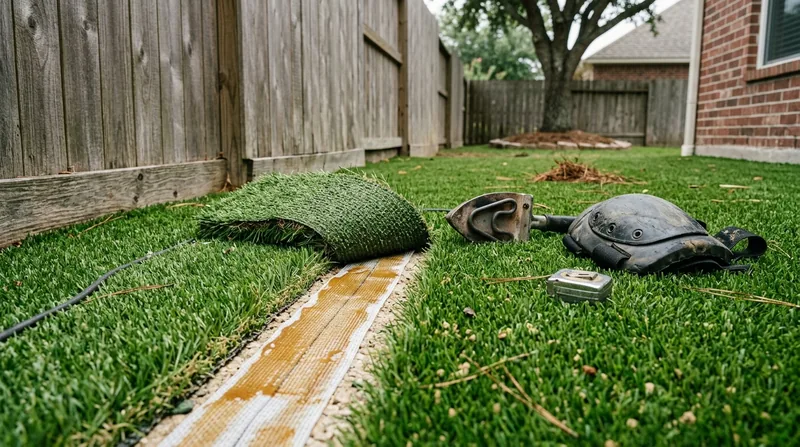




Houston's artificial turf installations face real wear: seams separate under the relentless heat and humidity, edges lift where foot traffic concentrates near pool gates and patio edges, and the gumbo clay beneath shifts after heavy rain, buckling the base and creating wrinkles that catch water. Turf repair and seam repair in Houston is not cosmetic work, it is structural restoration that keeps your investment functional and safe. Whether a seam has opened after three years of UV exposure, an edge has peeled up from a corner where kids cut the grass, or a section has flattened from a pet run, we locate the failure, cut and re-seam or replace the damaged panel, and restore the base if necessary. We have been doing this work since 2013 across Houston, Bellaire, Spring, Humble, Missouri City, and beyond, and we know exactly which repairs hold and which ones recur if the underlying cause is not fixed.
Why Seam Separation and Edge Lifting Happens in Houston's Climate
Artificial turf is glued at the seams with a polyurethane adhesive rated to hold under normal expansion and contraction. But Houston's temperature swings, the intense afternoon sun reflecting off concrete and brick, and the moisture trapped in our humid air create stresses that generic installation cannot always survive. Seams that were laid in February when it was 65 degrees will experience 40-degree temperature swings by summer, and if the base was not properly compacted or if the sub-base drainage was poor, water sits under the turf and weakens the adhesive bond. Edges lift where the perimeter is not fully secured or where a pet or child has pulled at a corner repeatedly. Wrinkles form when the base has settled unevenly or when the turf was installed too tightly without room for expansion.
- Seams fail most often in direct sun exposure, especially on south and west-facing yards where afternoon heat peaks above 120 degrees at the turf surface.
- Edge lifting occurs where the perimeter tape or securing method was not installed to specification or where foot traffic and pet activity concentrate stress.
- Wrinkles and buckles indicate base settlement, poor drainage, or installation without proper expansion allowance.
- Melt spots from window reflections or heat sources can damage the face fibers and require panel replacement.
- Flattened traffic lanes show where the infill has been compressed by repeated use and need re-raking and infill top-up.
Each of these failures has a specific cause, and addressing only the symptom leaves you with a repair that fails again within months.
Key info: Seam failures in Houston yards installed 2015 to 2020 often trace back to adhesive applied in cooler weather without proper cure time before heat arrived. We inspect the entire seam run, test the bond, and replace only the failed section with fresh adhesive and proper overlap, then monitor the repair through the next heat cycle.
For detailed guidance on comparing repair versus replacement, see our turf removal and replacement page.
How We Repair Seams and Edges: Our Process in Houston
Repair begins with a full site inspection: we photograph the failure, measure the affected area, test the adhesive bond on adjacent seams to determine if the problem is localized or systemic, and check the base for settling or drainage issues. If the base is compromised, we address that first, because a good seam glued over a soft or wet base will fail again. We then cut out the damaged section, clean the edges and the base with a solvent-based prep, apply new adhesive to the existing turf edges and the replacement panel, and press the seam together with proper overlap and dwell time. For edge lifting, we re-secure the perimeter with reinforced edging tape or ground stakes, depending on the yard layout and the failure mode.
- We inspect the full seam run and test adjacent bonds to identify whether the failure is isolated or part of a wider installation defect.
- We excavate and inspect the base for settling, water pooling, or compaction loss that could cause the repair to fail again.
- We cut out the damaged turf section with a straight edge and remove all old adhesive and debris from the cut edges and base.
- We apply new polyurethane adhesive to both the existing turf edge and the replacement panel, press and weight the seam for the manufacturer-specified cure time, typically 24 hours.
- For edge lifting, we re-secure the perimeter with reinforced seaming tape or ground anchors, depending on the location and the cause of the lift.
- We rake the infill in the repaired area and blend it with the surrounding turf to eliminate visible transitions.
The repair holds because we address the root cause first, not just the visible symptom.
Example: A West University Place backyard with a seam failure near the pool gate had a lifted edge caused by poor base compaction and a corner stake that had worked loose. We re-compacted the base, installed a reinforced ground anchor at the corner, and re-glued the seam with proper overlap and cure time. The repair has held for two years without recurrence.
Learn more about turf cleaning and maintenance to extend the life of your repair.
Repair Methods and When Each One Works
| Repair Method | Description | Best For |
|---|---|---|
| Seam Re-gluing | Cut out the failed seam, clean edges and base, apply fresh polyurethane adhesive, press and cure for 24 hours. | Isolated seam failures less than 2 feet long; adhesive bond has failed but turf is intact and base is sound. |
| Panel Replacement | Remove damaged turf section, inspect and re-prepare the base, install new turf panel with fresh adhesive and overlap. | Melt spots, large tears, severe wrinkles, or seam failures longer than 2 feet where the turf face is compromised. |
| Base Repair and Re-seaming | Excavate soft or settled base, compact and re-grade, then re-glue the seam or install new turf over the restored base. | Wrinkles, buckles, or repeated seam failures caused by base settlement, poor drainage, or compaction loss. |
| Edge Reinforcement | Re-secure lifted or peeling edges with reinforced seaming tape, ground anchors, or perimeter edging, depending on the failure mode. | Edge lifting, corner peeling, or perimeter separation caused by loose anchors, poor initial installation, or foot traffic stress. |
| Infill Blending and Raking | Re-rake infill in the repaired area, add fresh infill if needed, and blend with surrounding turf to eliminate visible transitions. | Any repair, to restore uniform appearance and drainage; part of every seam or panel repair work. |
The method we choose depends on the size and cause of the failure, the age and condition of the base, and whether the damage is isolated or part of a wider installation problem.
Turf Repair and Seam Repair Cost in Houston: What to Expect
Seam repair in Houston starts at $350 to $500 for a simple re-glue of a localized failure, covering the labor to cut, clean, prep, and re-glue the seam. Panel replacement runs $600 to $1,200 depending on the size of the damaged section and the cost of matching replacement turf. Base repair, if needed, adds $300 to $800 depending on the excavation depth and the extent of re-compaction required. Edge reinforcement runs $200 to $400 for a single corner or section, or more if the entire perimeter needs re-anchoring.
The final cost depends on several real factors: the size and location of the failure, whether the base is sound or needs excavation and re-compaction, the age of the original installation and whether matching replacement turf is available, and whether the problem is isolated or part of a systemic installation defect. A seam failure in a shaded corner of a Tomball patio is a quick $400 job. A wrinkle caused by base settlement under a pet run in Bellaire may require $800 to $1,200 in base work plus panel replacement. A yard with multiple seam failures across different areas may indicate a wider installation problem that requires a full site assessment and a more substantial repair scope.
We always provide a detailed written estimate before work begins, including the specific repair method, materials, and labor. For a comprehensive pricing overview and comparisons across our full range of services, visit our pricing page.
What to Look for When Hiring a Turf Installation Company Near Me for Repair Work
Not every turf crew can repair seams correctly. Many itinerant installers will glue over a soft base or apply adhesive without proper cure time, and the repair fails within weeks. When you are hiring someone to fix your turf, check that they carry a certificate of insurance naming general liability and workers' compensation, ask for references from at least two previous repair jobs, and request a written estimate that names the specific repair method, the materials (including the adhesive type and cure time), and the labor scope. Ask whether they will inspect and address the base if needed, or if they are just gluing over whatever is underneath. Request photos of similar repairs they have completed.
- Verify that the company carries current general liability and workers' compensation insurance and can provide a certificate on request.
- Ask for written references from previous repair jobs in Houston or nearby areas, and follow up with at least one to confirm the repair held.
- Request a written estimate that specifies the repair method, the materials (adhesive type, cure time, replacement turf product if needed), and the labor scope.
- Clarify whether the estimate includes base inspection and repair if needed, or if base work is a separate cost added after excavation.
- Ask about the warranty on the repair work itself, which should be at least one year on the seam bond and the installation labor.
- Confirm that the company will monitor the repair through the next heat cycle and will stand behind the work if it fails prematurely.
A professional turf repair company will not shy away from these questions, and their answers will be specific and detailed, not vague or dismissive.
If you are ready to get started, contact us for a free, no-obligation estimate. We respond within 24 hours and will assess your repair need in person before giving you a firm price.
Turf Repair & Seam Repair in Houston: Pricing Guide
| Service | Price | Details |
|---|---|---|
| Seam Re-gluing | Starting at $350 | Localized seam failure repair, includes cutting, cleaning, adhesive application, and 24-hour cure; isolated failures under 2 feet long |
| Panel Replacement | Starting at $600 | Damaged turf section removal and replacement with new panel, adhesive, and infill blending; size of damaged area and matching turf availability affect final cost |
| Base Repair with Re-seaming | Starting at $800 | Excavation, inspection, and re-compaction of settled or soft base, then seam re-glue or panel replacement; depth of excavation and extent of compaction drive final estimate |
| Edge Reinforcement | Starting at $200 | Re-anchoring lifted or peeling edges with reinforced tape or ground anchors; single corner or full perimeter section, depending on failure extent |
| Complex or Multi-Section Repair | On estimate | Multiple seam failures, wide base damage, or systemic installation defects require on-site inspection before a firm number is given |
| Estimate and Travel | Free | No-obligation site visit and written estimate within 24 hours; travel included in Houston and surrounding service areas, no mileage fee |
Indicative pricing, the exact cost depends on square footage, finish, and site access. Free personalized estimate within 24h at (346) 202-2866.


