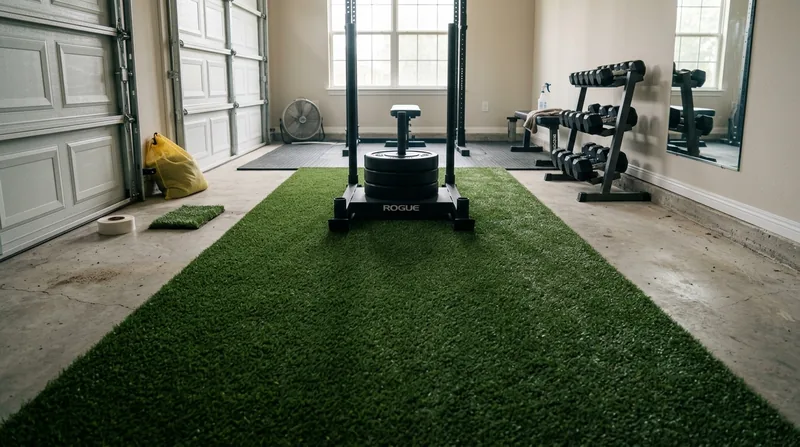




Sports, Gym & Court Turf in Houston demands a synthetic surface built to handle intense foot traffic, rapid directional changes, and the flat-court demands of basketball, pickleball, volleyball, and fitness training. Houston's humid subtropical climate, with temperatures regularly exceeding 90°F from May through September and sudden downpours that soak clay soils, makes a properly installed athletic turf surface a practical choice for gyms, private courts, training facilities, and multi-sport complexes across the metro area. Unlike residential yards or pool surrounds, sports turf must deliver consistent ball response, predictable player deceleration, and drainage that handles both the seasonal Gulf Coast rainfall and the concentrated wear patterns of competitive play. We install artificial turf for sports and athletic facilities with specifications tuned to the sport, the facility type, and Houston's specific climate demands. Since 2013, we've sized turf systems for private basketball courts in Memorial, pickleball clubs in Spring, CrossFit boxes in EaDo, and gym flooring across Bellaire and West University Place. This page covers how we build court and gym turf that performs, what to expect in cost, and how to vet any turf installer before committing.
Why Athletic Turf Matters in Houston's Heat and Humidity
Houston's summer heat and year-round humidity create specific challenges for sports surfaces. Real grass in full sun dies under constant foot traffic; concrete and hardwood absorb and radiate heat that can exceed 140°F, creating injury risk and player discomfort. Synthetic turf for courts and gyms is engineered to resist UV degradation, provide consistent playability regardless of weather, and dissipate heat through proper infill selection and drainage design. Sports facilities that operate year-round or host multiple teams and classes cannot afford the downtime of grass repair or seasonal dormancy.
- We specify turf face weight and pile height to match the sport (lower pile for basketball and pickleball, higher for flag football and field hockey).
- We select infill type and depth to support ball response, player traction, and impact absorption without compromising drainage in Houston's heavy rain events.
- We install proper base preparation, including compacted stone and a geotextile underlayment, so standing water never pools and courts drain within hours of a thunderstorm.
- We choose heat-rated turf materials and light-colored infill options to reduce surface temperature during peak summer use.
A well-built athletic turf surface extends the usable season and reduces liability for heat-related injuries or slip-and-fall incidents.
Key info: Houston facilities operating in full sun should specify cooling infill and consider a lighter turf color. Basketball courts and pickleball facilities in Bellaire and West University Place often benefit from partial shade trees or pergolas, which reduce surface temperature by 15 to 25 degrees Fahrenheit while preserving court playability.
For guidance on regulations specific to your facility, check the Houston Planning and Development Department, which handles permitting for commercial sports facilities and recreational structures.
How We Build Athletic Turf: Site Prep, Drainage, and Specification
Installing artificial turf for gyms and courts is not a roll-and-glue job. The foundation determines playability, durability, and whether the court drains or holds water. We begin with a site visit to measure the footprint, assess drainage patterns, identify utilities, and understand the intended sport and use intensity. From there, we develop a written specification naming the turf product, face weight, pile height, infill type and application rate, base depth, and compaction method. Every facility gets a custom design because a batting cage turf system differs fundamentally from a pickleball court turf or a gym training floor.
- We remove existing surface material and excavate to the required base depth, typically 4 to 6 inches for athletic courts.
- We compact a stone base (usually 3 to 4 inches of recycled asphalt or crusher run) to ensure a stable, well-draining foundation that resists settling.
- We lay a geotextile underlayment and a secondary drainage layer to direct water away from the court surface and into perimeter or subsurface drainage.
- We unroll the turf, seam it with adhesive and reinforcement tape, and apply the specified infill at the correct rate (typically 12 to 16 pounds per square foot for athletic turf).
- We brush and settle the infill, test drainage, and perform a final walkthrough to confirm ball response and player traction meet the facility's requirements.
The result is a court or gym floor ready for immediate use, with no curing time and consistent performance through the Houston summer and into fall.
Example: A private basketball court in Humble required a 2,800-square-foot installation on a sloped lot with poor drainage. We excavated 5 inches, compacted a 4-inch stone base with a 1-inch secondary drainage layer, installed a premium 50-ounce-face-weight turf with 0.75-inch pile, and applied 14 pounds per square foot of shock-absorbing infill. The court drained completely within 2 hours of a 2-inch rainfall and delivered consistent ball bounce across the entire playing surface.
For more information on our base preparation standards, see our turf repair page, which details how we assess and rebuild compromised foundations.
Athletic Turf Installation Methods and Specifications
| Approach | Description | Best for |
|---|---|---|
| Full-depth base with stone and geotextile | Excavate to 5 to 6 inches, compact recycled asphalt or crusher run, install geotextile and secondary drainage, lay turf with 12 to 16 lbs per sq ft infill. | Basketball courts, pickleball facilities, multi-sport gyms, outdoor athletic fields, high-traffic training areas. |
| Shock-pad system with premium infill | Install a 1 to 2-inch closed-cell foam or rubber shock pad beneath the turf, then apply a lower infill rate (8 to 10 lbs per sq ft) for maximum impact absorption. | Crossfit boxes, training gyms, indoor courts, facilities where player comfort and injury reduction are priorities. |
| Concrete or hardwood overlay | Install turf directly over existing concrete or wood with a moisture barrier and drainage underlayment, no excavation required. | Gym renovations, existing hardwood court conversions, indoor facilities where structural changes are limited. |
| Modular tile system | Pre-fabricated turf tiles that interlock and lock down with adhesive, allowing partial replacement and reconfiguration without full re-installation. | Fitness studios, training facilities with changing layouts, spaces where future modifications are anticipated. |
| Batting cage and sport-specific turf | High-durability turf with reinforced backing and heavy infill (16 to 20 lbs per sq ft), designed for repetitive impact and ball strike zones. | Batting cages, pitching mounds, practice areas, facilities where ball impact and wear are concentrated in high-stress zones. |
Each method is selected based on the existing site condition, the sport, budget, and long-term facility goals. We provide a written specification for every installation so you know exactly what materials and methods are being used.
Sports, Gym & Court Turf Cost in Houston: What to Expect
Athletic turf is a capital investment, and pricing depends on site condition, turf specification, and the complexity of base preparation. For a typical court or gym floor in Houston, sports turf installation starts at $8 per square foot for a standard specification (40 to 50-ounce face weight, 0.75-inch pile, 12 to 14 pounds per square foot infill, 4-inch compacted stone base). A 2,000-square-foot facility at that rate runs $16,000 to $18,000 before site-specific factors. Facilities requiring shock pads, premium infill, or extensive drainage remediation can range from $12 to $16 per square foot. Batting cages and high-wear areas typically run $10 to $14 per square foot due to heavier infill and reinforced backing.
Factors that move cost up include poor existing drainage (requiring deeper base prep or French drains), trees or structures limiting access, sloped or uneven terrain requiring grading, and custom seaming for irregular court shapes. A facility with good existing grading and straightforward access will cost less than one requiring significant earthwork. We always measure on site and provide a detailed estimate before scheduling work.
See our full pricing page for cost ranges by facility type and surface area. We recommend getting 2 to 3 estimates so you can compare specifications, not just prices. The lowest quote often reflects lower-quality materials or inadequate base preparation, which leads to drainage failure or premature wear.
Sports, Gym & Court Turf Near Me: How to Hire a Qualified Turf Installation Company
Athletic turf is specialized work, and not every turf installer has the experience or equipment to build a court or gym floor that performs. When evaluating any turf installation company near Houston, look for evidence of capability and accountability. Ask to see a written specification that names the turf product, face weight, pile height, infill type and application rate, base depth, and compaction method. A contractor who cannot or will not provide a specification in writing is cutting corners. Request references from similar facilities (other courts, gyms, or training spaces) and ask about drainage, ball response, and any issues during the first year of use. Check that the company carries a certificate of insurance naming general liability and workers' compensation coverage.
- Verify the company has a local Houston address and can be reached by phone at the number provided.
- Ask how long the company has been installing athletic turf and whether the crew has experience with your specific sport or facility type.
- Confirm that the company includes a workmanship warranty covering seams, drainage, and turf adhesion for at least one year.
- Understand whether the facility or HOA requires architectural approval for the turf color, pile height, or edging (most do not, but some private facilities do).
- Ask about low-maintenance care: how to rinse infill after heavy use, when to brush the pile to restore appearance, and what to do if a seam lifts or a spot melts from reflected window heat.
We are fully insured and provide every specification in writing, with references and photos of completed courts and gyms across Houston. Call us at (346) 202-2866 or contact us online for a free, no-obligation estimate. We measure your facility, discuss your sport and use intensity, and send a detailed proposal within 24 hours.
Sports, Gym & Court Turf in Houston: Pricing Guide
| Service | Price | Details |
|---|---|---|
| Standard athletic court or gym floor | Starting at $8/sq ft | 40 to 50-ounce face weight turf, 4-inch stone base, 12 to 14 lbs per sq ft infill, good drainage |
| Premium or shock-pad system | Starting at $12/sq ft | 50 to 60-ounce turf with 1 to 2-inch foam or rubber shock pad, higher infill rate, maximum impact absorption |
| Batting cage or high-wear surface | Starting at $10/sq ft | Reinforced backing, 16 to 20 lbs per sq ft infill, heavy-duty turf rated for repetitive ball impact and concentrated wear |
| Site with poor drainage or extensive grading | On estimate | Requires deeper base prep, French drains, or subsurface remediation; measured on site before pricing |
| Travel and site visit | Included | No separate mileage or call-out fee within Houston and surrounding service areas |
| Free estimate and specification | No charge | Written proposal within 24 hours, includes turf product, face weight, pile height, infill type, and base depth details |
Indicative pricing, the exact cost depends on square footage, finish, and site access. Free personalized estimate within 24h at (346) 202-2866.


